5 Reasons Fort Worth Executives Need a Personal Chauffeur
You’re sitting in bumper-to-bumper traffic on I-35, trying to prep for the biggest pitch of your quarter while also watching for that aggressive driver weaving between lanes. Your laptop is balanced precariously on the passenger seat. You’re rehearsing talking points out loud. And you just missed your exit because you were distracted by an email notification.
Sound familiar?
If you’re a Fort Worth executive, this scenario probably happens more often than you’d like to admit. You’ve built a successful career making smart decisions about where to invest your time, energy, and resources. Yet somehow, you’re still spending hours each week behind the wheel, treating your car like a mobile office that’s neither mobile nor an effective office.
Here’s what successful executives across Dallas-Fort Worth are figuring out: hiring a personal chauffeur in Fort Worth isn’t about luxury or showing off. It’s about reclaiming the most valuable resource you have – your time – and using it strategically instead of wasting it in traffic.
Let me show you exactly why the most productive executives are making this shift, and why waiting any longer might be costing you more than you realize.
Reason 1: Your Time Is Worth More Than You’re Treating It
Let’s do some quick math that might make you uncomfortable.
If you’re a senior executive, your effective hourly rate is probably somewhere between $200-500 per hour when you factor in your total compensation. Maybe higher.
Now calculate how many hours per week you spend driving. Commuting to the office. Driving to client meetings. Airport runs. Business lunches across town. Conference pickups.
For most Fort Worth executives, that number is somewhere between 8-15 hours per week. Let’s be conservative and say 10 hours.
At $300 per hour, that’s $3,000 worth of your time each week spent doing something that literally anyone with a driver’s license can do. That’s $156,000 per year of executive-level thinking time spent navigating traffic and looking for parking.
Here’s the uncomfortable truth: you can’t get that time back. Every hour you spend driving is an hour you’re not closing deals, strategizing with your team, or thinking through complex business problems that actually require your expertise.
Professional chauffeur services understand this calculation intimately. When you hire a personal chauffeur, you’re not paying for transportation – you’re buying back your most valuable hours and converting drive time into productive work time.
The most successful executives I know stopped asking “Can I afford a chauffeur?” years ago. They started asking “Can I afford not to have one?”
Reason 2: Your Car Becomes a Mobile Office That Actually Works
Picture this instead: You slide into the back of a professionally maintained vehicle. Climate controlled to exactly your preference. Your chauffeur already knows the route, the traffic patterns, and has built in buffer time for your meeting.
You open your laptop. No distractions. No navigation to manage. No other drivers to monitor. Just focused work time.
In that same commute that used to be wasted, you can:
Review presentation materials and rehearse your pitch without distraction. Take confidential client calls without worrying about speakerphone in traffic. Respond to those accumulated emails that need thoughtful replies. Draft strategy documents that require deep focus. Conduct video calls with clients or team members in different time zones.
This isn’t theoretical. Fort Worth executives using personal chauffeur services report getting back 60-80% of their commute time as productive work hours.
Think about what that means practically. If you’re spending 10 hours per week in transit, you’re suddenly getting 6-8 hours back as usable work time. That’s nearly a full workday of productivity you’re currently losing.
The difference between sitting in the driver’s seat and sitting in the back seat isn’t just comfort – it’s the difference between time lost and time leveraged.
Reason 3: Client Impressions Start Before the Meeting
You pull up to your client meeting in your personal vehicle. You’re a few minutes late because parking was impossible. You’re slightly flustered. You’re carrying your briefcase and trying to remember where you parked so you don’t forget later.
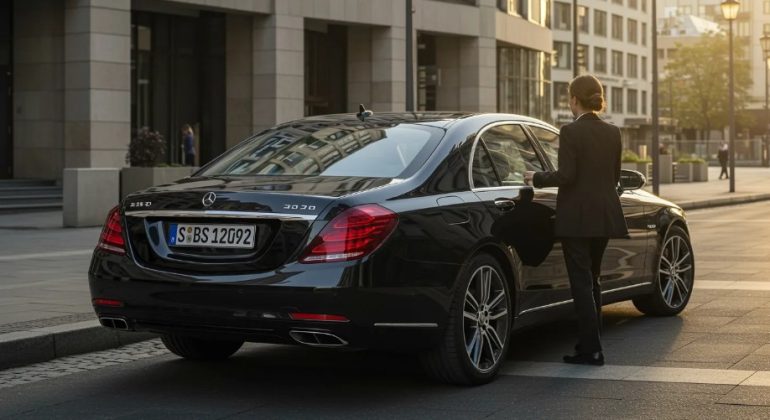
Contrast that with this: A luxury vehicle pulls up exactly on time. Your chauffeur opens the door. You step out looking composed, prepared, and completely unhurried. The client watching from their office window just got their first impression of how you operate – and it’s flawless.
In executive business, perception isn’t everything, but it’s not nothing either.
The clients you’re meeting with – especially high-value prospects – are evaluating everything. How you show up matters. Whether you’re flustered or composed matters. Whether you’re scrambling with logistics or completely focused on them matters.
When you arrive via professional chauffeur service, you’re communicating something important: you’re successful enough that your time is allocated strategically. You’re detail-oriented enough to ensure even your transportation reflects professionalism. You’re the kind of person who plans ahead and values quality.
I’ve heard countless stories from executives who landed major deals partly because their attention to detail – including how they arrived at meetings – impressed prospects. Nobody closes a deal solely because they showed up in a chauffeured vehicle. But nobody wants to work with someone who shows up frazzled and late either.
First impressions compound. Make them count.
Reason 4: The Hidden Cost of Driver Fatigue
Here’s something most executives don’t talk about: the mental exhaustion of driving in DFW traffic is real, measurable, and affecting your performance.
You’ve experienced this. You get to the office after a rough commute and you’re already drained. That creative problem-solving energy you need for the morning strategy session? You used it navigating construction on I-30 and dealing with aggressive drivers.
You finish a demanding full day of meetings, negotiations, and decisions. Now you face the evening commute home. You’re tired. Your reaction time is slower. Your patience is thinner. And you’re piloting a two-ton vehicle in heavy traffic while mentally and physically exhausted.
This isn’t sustainable, and it’s not safe.
Professional chauffeurs are trained, alert, and managing one job – getting you safely to your destination. They’re not mentally exhausted from back-to-back meetings. They haven’t spent the day solving complex business problems. They’re fresh, focused, and handling the one thing you’re trying to do while depleted.
Beyond safety, there’s the energy equation. Every executive has a finite amount of decision-making energy each day. Spending that energy on traffic navigation, route decisions, and defensive driving is borrowing from the energy you need for actual executive decisions.
When you eliminate driving from your daily equation, you show up to meetings sharper. You get home with enough mental energy left to actually enjoy your evening. You’re not constantly in that low-level stress state that comes from managing traffic.
The most successful executives I know are ruthless about energy management. They’ve figured out that preserving mental bandwidth for high-value decisions means eliminating low-value tasks – including driving themselves around town.
Reason 5: Work-Life Balance Isn’t a Luxury – It’s a Necessity
Let’s talk about what happens at the end of your workday.
Most Fort Worth executives are working 10-12 hour days minimum. You’re making high-stakes decisions. Managing teams. Dealing with complex challenges. It’s demanding work that requires your best thinking.
Then you climb behind the wheel for a 45-minute commute home through rush hour traffic.
By the time you walk through your door, you’re depleted. Your family gets whatever’s left of you after traffic took the rest. You’ve got maybe two hours before you need to be thinking about sleep and doing it all again tomorrow.
This pattern isn’t sustainable long-term, and you know it.
Now imagine this alternative: Your workday ends. Your chauffeur is already waiting. You settle into the back seat. You can decompress. Take a breath. Make the mental transition from work mode to home mode at your own pace.
You can take a call with your spouse about weekend plans. You can sit in silence and just think. You can read something unrelated to work. You can mentally shift gears so that when you walk through your door, you’re actually present.
The executives who’ve made this transition talk about getting their evenings back. Not just the time – the mental space. They’re not showing up at home still in traffic-brain mode. They’re arriving ready to actually be present with their families.
Work-life balance isn’t about working fewer hours. It’s about creating boundaries where you can actually transition between roles. A DFW chauffeur service provides that transition space naturally.
You’re still getting those hours back. But instead of using them for more work, you’re using them to decompress, reflect, and prepare mentally for being present in your personal life.
The Real Cost of Waiting
I know what you’re thinking. This sounds great in theory, but the practical question is always: Is this really worth the investment?
Here’s a better question: What’s the cost of not making this change?
Calculate the opportunity cost of those 500+ hours per year you’re spending behind the wheel. Think about the client relationships that might deepen if you showed up more composed and prepared. Consider the strategic thinking you’re not doing because you’re mentally exhausted from commuting.
Factor in the compounding stress on your health and relationships from being constantly in traffic-induced fight-or-flight mode. Add up the meetings you’ve been late to, the calls you’ve had to reschedule, the moments with family you’ve missed because you were stuck on I-35.
The most expensive decision is often the decision to keep doing what you’ve always done because you haven’t stopped to calculate what it’s actually costing you.
Fort Worth’s most successful executives aren’t using personal chauffeurs because they’ve “made it” and want to show off. They’re using chauffeurs because they’ve done the math and realized that their time, their energy, and their mental bandwidth are too valuable to waste on low-level tasks.
Making the Transition
If you’re reading this and recognizing yourself in these scenarios, the question isn’t whether you should consider a personal chauffeur – it’s why you’re still waiting.
Start with the areas where the impact would be most immediate. Maybe that’s airport transportation for business travel. Maybe it’s client meetings where first impressions matter. Maybe it’s your daily commute where you’re losing the most productive hours.
Professional chauffeur services in Fort Worth can customize to exactly what you need. You don’t have to commit to full-time immediately. But starting somewhere means you start reclaiming time, energy, and effectiveness immediately.
The executives who make this transition consistently report the same thing: they wish they’d done it sooner. Once you experience what it’s like to use your commute time productively, to show up to meetings composed instead of frazzled, to have that buffer between work and home – going back feels impossible.
Your Next Move
You didn’t get to the executive level by being inefficient with resources. You got there by making strategic decisions about where to invest time, money, and energy for maximum return.
Hiring a personal chauffeur is exactly that kind of strategic decision.
It’s choosing to invest in your productivity, your effectiveness, your client relationships, and your quality of life. It’s recognizing that your time is genuinely valuable and treating it accordingly.
The Fort Worth executives who are winning aren’t working longer hours than you. They’re working smarter. They’ve eliminated low-value tasks. They’ve created systems that multiply their effectiveness.
Transportation is one of those systems.
You have two choices: keep doing what you’re doing and accept the costs that come with it, or make a change that immediately impacts your productivity, your presence, and your peace of mind.
The most successful people don’t wait for perfect timing. They recognize when something makes strategic sense and they execute.
This is one of those decisions. Make it count.
